Website traffic but no leads: diagnosing the B2B conversion funnel
In short. A website conversion funnel turns visitors into leads across stages: arrival, engagement, intent, and action. When traffic grows but leads don’t, the constraint is usually a single leaky stage — wrong-intent traffic, weak offers, or friction in the form. Diagnose stage by stage with analytics, fix the biggest drop first, and measure lead quality, not just volume.
Your website conversion funnel is the path a visitor takes from landing on a page to becoming a lead — and when that path leaks, more traffic won’t save you. We see this pattern constantly in audits: sessions are up 30–40% year over year, the SEO dashboard looks healthy, and yet the sales team still complains that nothing comes in. According to Think with Google, most B2B buyers do the majority of their research before ever contacting a vendor, which means your site has to earn the inquiry — traffic alone doesn’t.
So the real question isn’t “how do we get more visitors”. It’s “why are the visitors we already have not turning into leads”. That’s a diagnosis, not a slogan. In this article we’ll walk the funnel stage by stage, show you where the drop-off usually hides, and give you a way to find your own constraint — the single stage costing you the most leads — so you fix that first instead of rebuilding everything on a guess.
Is your traffic actually the right traffic?
The first thing to check isn’t the form or the copy — it’s whether the people arriving ever intended to buy. A large share of “traffic but no leads” cases come down to intent mismatch: the page ranks for terms that bring readers, not buyers.
Here’s the pattern we look for in a funnel analysis:
- Top landing pages are informational blog posts with high bounce and almost no path toward a contact page.
- Branded or navigational queries dominate, meaning people already know you and don’t need to convert again.
- Paid or social traffic lands on a homepage instead of a page matched to the ad’s promise.
If your highest-traffic page answers a question but never asks for anything, it’s doing its job as content and failing its job as a funnel entry.
Pull your landing pages by entrances and segment them by intent. Separate “someone researching a problem” from “someone comparing solutions” from “someone ready to act”. In one B2B audit we ran, 70% of organic sessions landed on three guide articles with no next step — the traffic was genuine, the intent simply wasn’t commercial yet. The fix there wasn’t more volume; it was adding a relevant mid-funnel offer to those guides.
Where exactly does the funnel leak?
Direct answer: break the funnel into four stages — arrival, engagement, intent, action — and measure the drop-off at each. The biggest percentage drop between two stages is your constraint, and it’s usually one stage, not all four.
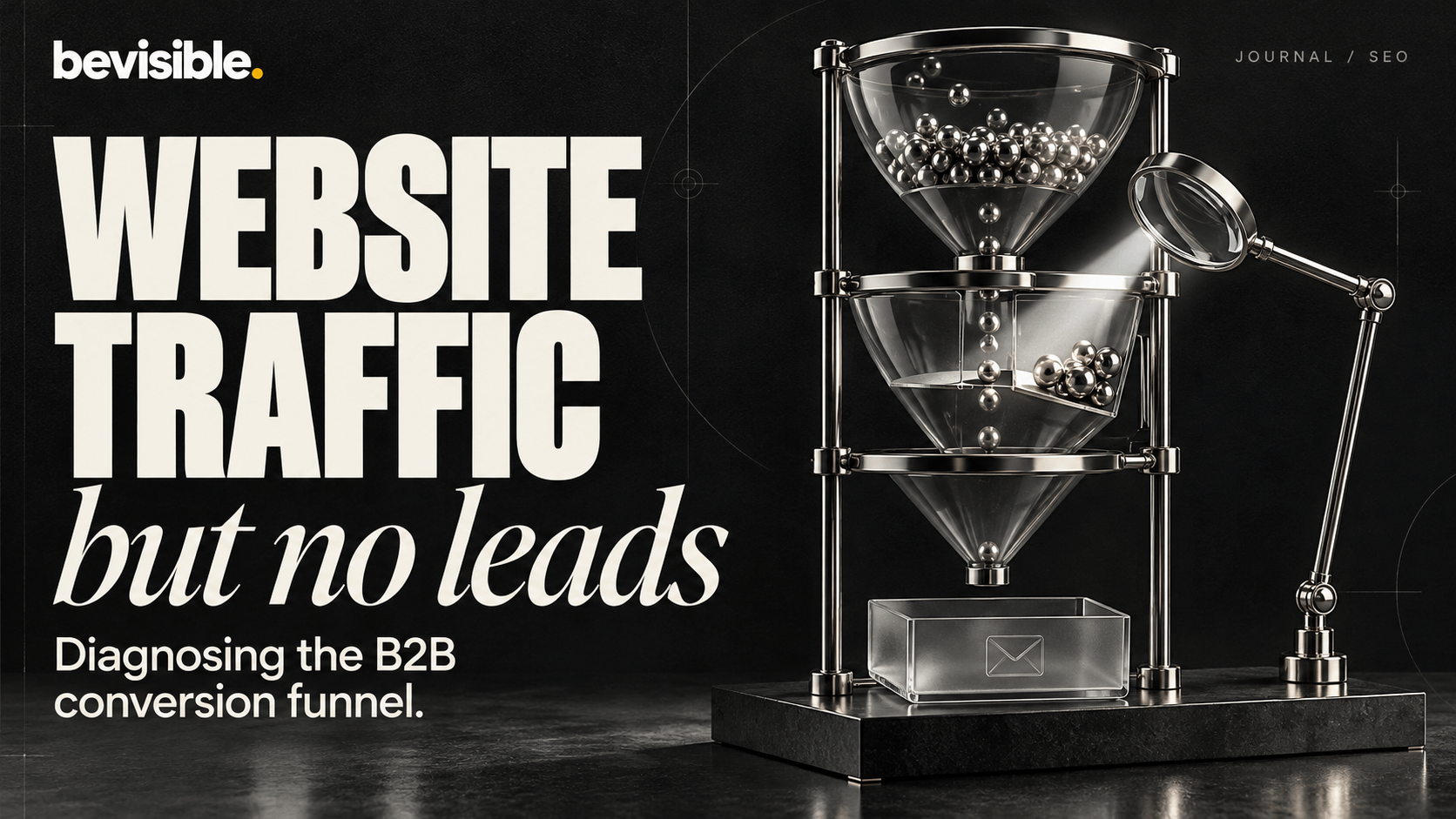
A website conversion funnel analysis works like a pipe inspection. You don’t replace the whole pipe; you find the leak. Map your stages like this:
- Arrival — sessions that land on a page capable of converting.
- Engagement — visitors who scroll, read, or click beyond the first screen.
- Intent — visitors who reach a pricing, demo, contact, or service page.
- Action — visitors who start and complete a form or booking.
Now put a number on each transition. If 1,000 people arrive, 600 engage, 120 reach an intent page, and 8 submit, your worst leak is the intent-to-action step: you lost 93% of qualified-looking visitors at the final hurdle. That’s where you work.
Most teams skip this and change the headline because it’s visible. But the data tells you where the money leaks. Tools from Semrush and your own analytics make this measurable in an afternoon — the discipline is resisting the urge to fix the stage that merely annoys you rather than the stage that actually loses leads.
Why isn't your landing page converting?
If a landing page is not converting, the usual causes are a mismatch between the promise that brought the visitor and the message they find, plus too much asking before any value is given. Visitors decide in seconds whether they’re in the right place.
When we audit a page that pulls traffic but no leads, we check three things in order:
- Message match. Does the headline repeat the exact promise of the ad, link, or search query? Nielsen Norman Group‘s research on scanning behaviour shows users confirm relevance fast — a vague headline loses them before they read a word.
- Clarity of offer. Can a visitor tell, in one sentence, what you do and who it’s for? B2B pages often bury the offer under abstract language.
- One primary action. Pages with five competing buttons convert worse than pages with one obvious next step.
A landing page isn’t a brochure. It has one job — move this specific visitor one step closer to talking to you.
In practice we often find the page is fine for a browser but wrong for a buyer. It explains features at length and never names the outcome the buyer cares about. Rewriting the first screen around the visitor’s problem — not your product — frequently lifts conversion more than any design change.
Is your form doing more harm than good?
Direct answer: forms are where motivated visitors give up. Lead form optimization — cutting fields, clarifying what happens next, and reducing friction — often recovers more leads than any other single change, because these are people who already wanted to act.
The intent-to-action leak we mentioned earlier usually lives in the form. We’ve seen forms that ask for company size, budget, and phone number before the visitor has any reason to trust you. Every extra field is a reason to leave.
A short checklist we apply to B2B forms:
- Ask only for what you genuinely need to start a conversation — often just name and email.
- Replace “Submit” with a label that states the outcome (“Get my audit”, “Book a 20-minute call”).
- Tell people what happens next and when, so submitting doesn’t feel like a leap into silence.
- Make errors obvious and forgiving, and never clear a filled form on a single mistake.
In one audit, trimming a seven-field form to three and changing the button copy lifted completions by roughly a third within a month — with no change in traffic. Those leads were always there; the form was quietly turning them away. Before you commission new traffic, make sure the people you already have aren’t bouncing off your last step.
What does a B2B conversion rate actually tell you?
Direct answer: a B2B website conversion rate — visit-to-lead — is useful as a trend, not an absolute. Common ranges sit around 1–3%, with strong sites reaching 4–5%, but your own baseline and lead quality matter far more than any public benchmark.
B2B conversion rate optimization goes wrong when teams chase a number they read in a blog. Your industry, traffic mix, and offer all move the figure. A consultancy selling a £50k engagement will never convert at the rate of a free template download — and shouldn’t try to.
What we actually look at:
- Your trend over time. Is the rate improving as you fix stages? That’s the signal that matters.
- Rate by source. Organic, paid, and referral convert very differently; a blended number hides the truth.
- Rate by page. Your best page is your internal benchmark — pull everything else toward it.
Chasing an industry average is borrowing someone else’s funnel. Beat your own last quarter and you’re winning.
A rising conversion rate on wrong-fit leads isn’t progress. That’s why the next question — quality — matters as much as the percentage itself.
Are you measuring lead quantity instead of lead quality?
Direct answer: a funnel that produces many unqualified inquiries isn’t healthy. Track qualified leads and pipeline, not raw submissions — otherwise you optimise toward noise and the sales team quietly stops trusting the form.
We’ve watched teams celebrate a doubling of form fills that produced zero new opportunities. The funnel looked fixed; the business wasn’t. The leads were students, job-seekers, and competitors — anyone but buyers.
To keep quality in view, connect the funnel to what happens after the form:
- Tag each lead with its source and landing page, so you know which pages produce real opportunities.
- Ask one qualifying question on the form — role, company, or need — without making the form heavy.
- Review with sales monthly: which leads became conversations, which were noise.
In a B2B lead generation funnel, the goal is the right visitor taking the right action. If your top-converting page brings volume but no pipeline, the honest move is to change the offer or the targeting, not to celebrate the number. Quality feedback from sales is the cheapest diagnostic you have — use it to decide which stage to work on next.
Should you run a conversion audit before redesigning?
Direct answer: yes. A website conversion audit tells you which stage actually leaks, so your effort lands where the leads are lost. Redesigning on instinct often polishes a stage that was never the problem and leaves the real leak untouched.
A redesign feels like progress because it’s visible and large. But if your constraint is a seven-field form or a mismatched headline, a beautiful new homepage changes nothing. We’ve seen six-figure rebuilds that moved conversion by almost zero because the actual leak survived the redesign intact.
A conversion audit is faster and cheaper than you’d expect. The sequence we follow:
- Measure the four-stage funnel and find the largest drop.
- Review the leaking stage with analytics plus session recordings to see real behaviour.
- Form a short list of hypotheses and rank them by likely impact and effort.
- Test the top one or two, measure, and only then decide whether a redesign is justified.
Fix the leak first, redesign second. A pretty funnel that still leaks is just a more expensive leak.
Once you know your constraint, improvement becomes cheap and specific instead of broad and uncertain. That’s the whole point of diagnosing before building — you spend your budget on the stage that’s actually costing you leads, and you can prove the gain afterward.