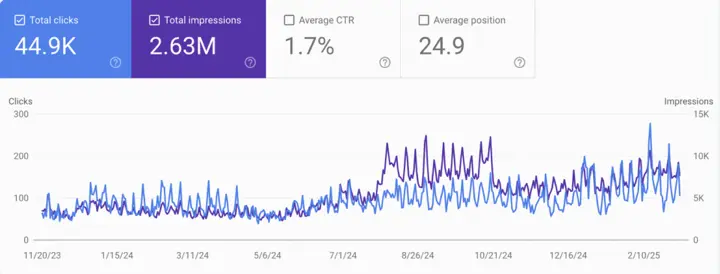
Maze Rooms is a chain of escape (quest) rooms with several locations across Los Angeles. At the start of our collaboration (November 2023), mazerooms.com was bringing in around 955 organic visits and 29 SEO leads per month. The ask was direct: more relevant traffic from search and more bookings.
We approached this not as a set of separate fixes, but as a single working model: the site is the core, and around it work the technical foundation, semantics, content, the link profile and local visibility. In the first year the site reached the TOP for the city's main commercial queries; over the engagement organic traffic grew roughly ×4, and the number of SEO leads roughly ×3.9.
Below — what we saw in the data, which hypotheses we tested, and which of them became a verified pattern for us.
What we changed in Maze Rooms' SEO system
The main focus wasn't on point fixes, but on making the technical foundation, semantics, content, schema markup and link profile work as one system. Each block reinforced the others: a clean technical base gave the foundation for indexing, semantics set the structure, content covered demand, microdata improved snippets, links added authority.
The working model we started from: in a local business, organic visibility is born not from a single channel, but from the connection — when the site structure, content, technical SEO and the local profile support one another. So we built not a task list, but a system.
What the SEO audit revealed
We ran a full technical audit (100+ check points). A few observations that set the priorities:
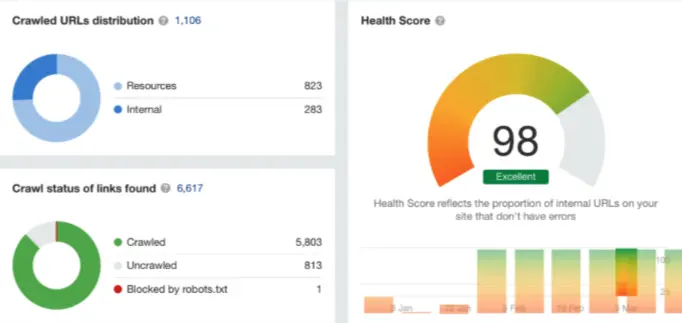
- The site's technical health was generally sound (after the fixes the Health Score reached 98/100), but structure and semantics weren't connected in a way that could scale traffic beyond a handful of brand and most-generic queries.
- Metadata and snippets weren't using the full SERP CTR potential — a hypothesis we later tested with rewritten meta tags and schema markup.
- Local visibility (Google Maps, "near me" queries) had room to grow that was barely tapped at the start.
We logged this as an observation, not a verdict on the site — and built the plan around what could be tested the fastest.
Why the SEO strategy worked
The main result came not from a single optimization, but from all the blocks starting to pull in one direction. Which of our hypotheses were confirmed as a pattern on this project:
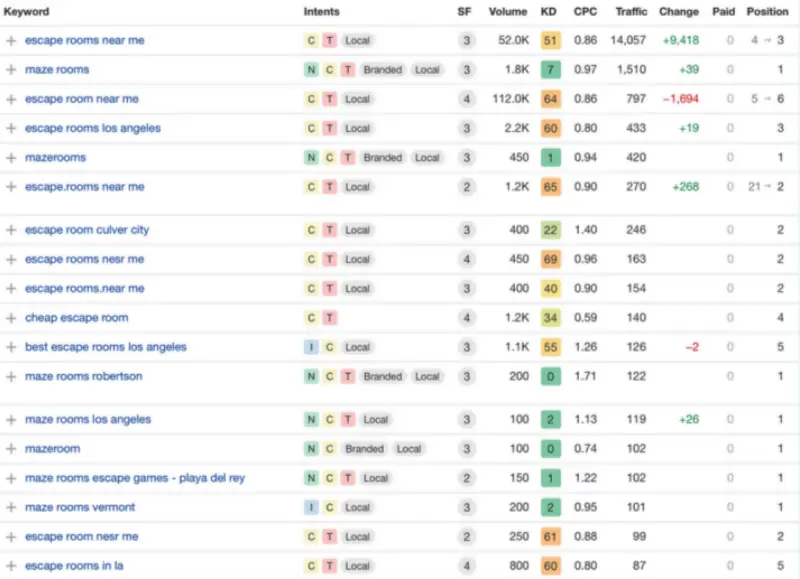
- A large semantic core (~3,000 keywords) + a systematic content plan gave the site a reason to rank for hundreds of relevant queries, not a dozen. We attribute the ~×4 traffic growth mainly to semantic coverage, not to individual pages.
- Quality links pointed precisely at priority commercial URLs helped push those pages into the TOP-10. For us this is a verified practice: targeted off-page for specific URLs works predictably.
- Microdata improved the snippets' appearance — the working CTR hypothesis was confirmed at the SERP level.
- Google Maps became a separate channel: after optimizing the profile, it began adding up to ~1,000 visits per month.
An open question we hold honestly: some of the broadest queries (for example, generic "escape room near me") depend heavily on local results and behavioral factors, so there we keep testing rather than treating the result as final.