B2B SEO services bring traffic but no pipeline: where the leak is
In short. If your B2B SEO services bring traffic but no pipeline, the leak is almost always intent and conversion, not rankings. We diagnose it by segmenting traffic by intent, checking whether pages match buyer stages, and auditing the path from landing to lead. Fix the three or four pages that actually carry commercial intent and pipeline usually follows faster than another content sprint.
Your B2B SEO services are working — on paper. Rankings are up, sessions climb month over month, the dashboard looks healthy. But the sales pipeline hasn’t moved. This is one of the most common things we see in audits, and the frustrating part is that traffic growth can mask the real problem for a long time. According to Ahrefs research, the vast majority of pages get little to no organic traffic at all, so when volume finally arrives it feels like success — even when none of it reaches a sales conversation.
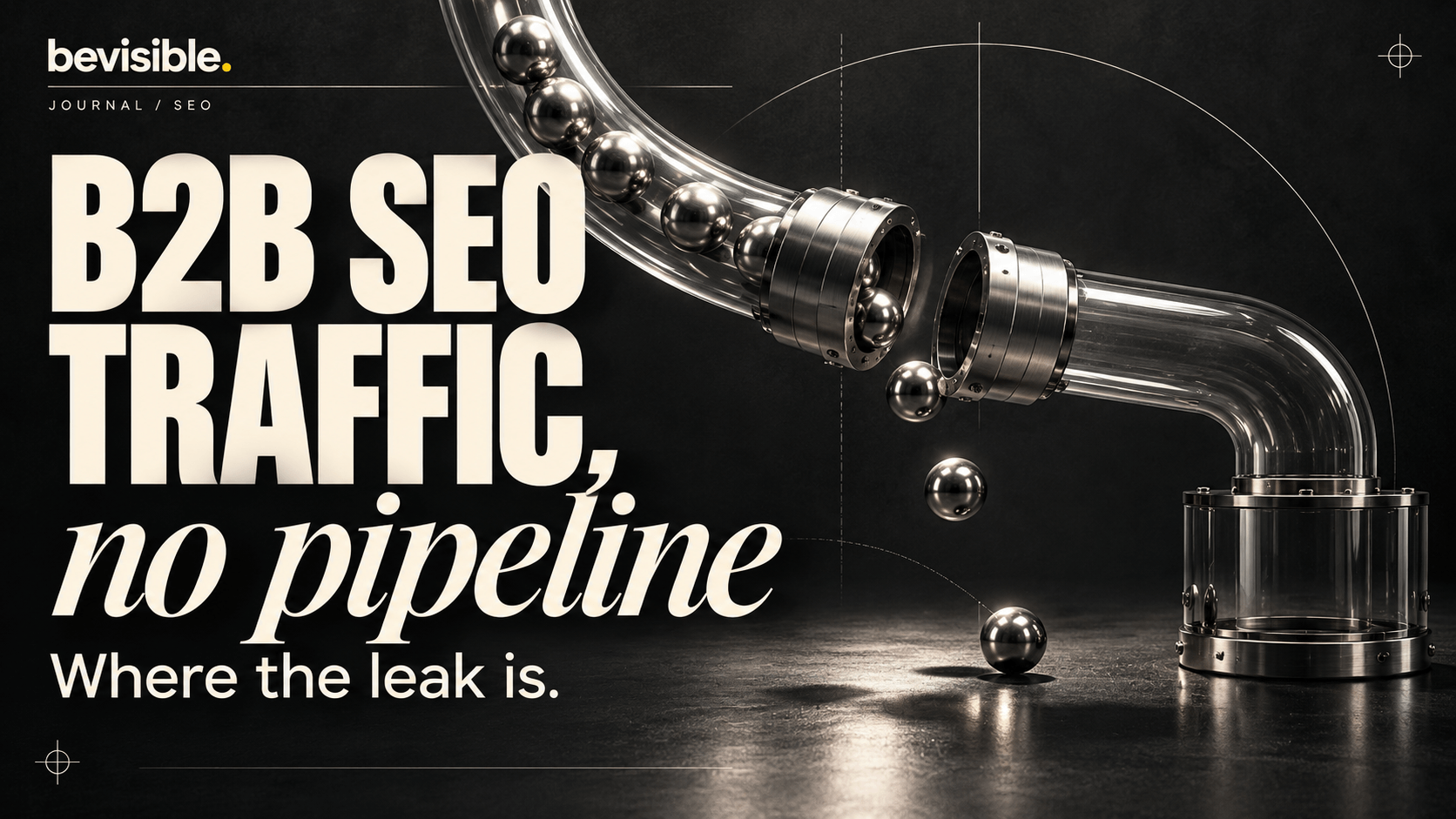
Here’s how we think about it: traffic is not the deliverable. Pipeline is. When those two numbers move in opposite directions, the leak is almost never in your rankings. It’s in the gap between what you rank for, where that traffic lands, and what visitors are asked to do next. Below we walk through the places that leak most often, in the order we check them.
Why does good traffic produce no leads?
Good traffic produces no leads when it’s the wrong kind of traffic for your buyer stage. Most “traffic-but-no-pipeline” sites rank well for informational queries and poorly for the commercial terms that signal buying intent. You get readers, not buyers.
The simplest test is to segment your organic landing pages by intent. Split them into three buckets:
- Informational — “what is”, “how to”, “guide”, definitions.
- Commercial — “best”, “services”, “software for”, “vs”, “pricing”.
- Navigational/brand — your name, product names.
In most audits where the complaint is “no leads”, 80% or more of organic sessions land on informational pages. That traffic is real, but it’s people learning, not people shortlisting a vendor. A visitor reading “what is content gap analysis” at the start of their research is years of context away from requesting a proposal.
Traffic without intent is an audience, not a pipeline. The job of B2B SEO is to win the queries people type when they’re ready to spend money — and then make sure those pages convert.
This doesn’t mean informational content is wasted. It builds authority and feeds remarketing. But if it’s the only thing ranking, your B2B SEO services are filling the top of the funnel and leaving the bottom empty.
Are your commercial keywords actually ranking?
Often, no. The pages that would generate pipeline — service pages, solution pages, comparison pages — are usually the weakest part of a B2B site. The direct answer: check whether you rank on page one for the terms a ready buyer uses, not just the terms a curious reader uses.
Pull your keyword rankings and filter only for commercial intent. For a B2B SEO agency, that’s terms like “b2b seo services”, “seo for b2b companies”, “b2b seo consultant”. For your business, it’s your service name plus modifiers your buyers actually type.
What we routinely find:
- The company ranks top-3 for dozens of blog topics.
- It ranks on page three or worse for its own core service term.
- Nobody has built a dedicated, optimised page for that commercial query at all.
This is the classic imbalance. Content production focused on volume because volume is easy to show in a report. Meanwhile the three or four pages that carry real intent were treated as an afterthought — thin copy, no unique angle, no proof.
The reason this matters: commercial queries have far lower volume but far higher conversion value. A page getting 200 visits a month from “seo services for b2b” can out-produce a blog post getting 5,000 visits from a how-to query. If your commercial pages aren’t ranking, the pipeline leak starts before the visitor ever arrives.
Is each page matched to the right buyer stage?
A page converts when its content matches where the visitor is in their decision. The leak appears when a buying-stage visitor lands on a learning-stage page, or the reverse. Mapping intent to buyer stage is where most B2B content strategies quietly fall apart.
Think of three stages and what each page should do:
- Awareness — the reader has a problem, not a solution in mind. Content educates and captures a soft action: a newsletter, a resource download.
- Consideration — they’re comparing approaches and vendors. Content should show your method, results, and differentiators, and offer a mid-weight action like a scorecard or audit.
- Decision — they’re ready to talk. Pages should remove friction: clear pricing logic, proof, a direct path to a conversation.
In our audits we regularly see decision-stage traffic — people who searched for a service and clicked a ranking page — dumped onto a 2,000-word explainer with a single “subscribe” box at the bottom. That visitor was ready to talk and found nothing to click. That’s a pure, avoidable leak.
The fix isn’t more content. It’s aligning the pages you already have to the intent that actually drives them, and making sure each stage has a next step that fits.
Where does the conversion path break?
The conversion path breaks wherever a high-intent visitor hits a dead end. After intent and ranking, the next leak is mechanical: the journey from landing page to lead has missing steps, confusing calls to action, or forms that ask too much.
Walk your own path as a buyer would:
- Land on a commercial page from search.
- Find the primary call to action — is it obvious within the first screen?
- Click it — does it go somewhere relevant, or back to a generic contact page?
- Reach the form — how many fields, and how much friction?
Nielsen Norman Group research on web usability has long shown that users scan rather than read and abandon quickly when the next step isn’t clear. On B2B pages this shows up as calls to action buried below long blocks of text, or three competing buttons so the visitor chooses none.
If a ready buyer has to think about what to do next, you’ve already lost most of them. One clear, relevant next step beats five clever ones.
Common breaks we flag in audits: a “Learn more” link that loops back to another blog post, a demo form with eleven required fields, and a thank-you page with no follow-up. Each one is a place where interested people leak out before they reach sales.
Is the offer worth converting for?
Sometimes the page, the ranking, and the path are all fine — and visitors still don’t convert because the offer is weak. The direct answer: a “contact us” button is not an offer. A reason to raise your hand right now is.
High-intent B2B visitors are cautious. They don’t want a sales call on their first visit; they want something concrete and low-risk. The strongest converting B2B pages pair a clear service with a specific, valuable entry offer.
Compare these two:
- “Contact us to learn about our B2B SEO services.”
- “Send us your domain and get a free pipeline leak audit showing where your traffic drops before it reaches sales.”
The second works because it’s specific, useful before any commitment, and tied directly to the visitor’s problem. It also lets you capture intent earlier, when the lead is warm.
We often find that a single sharper offer on the main service page moves the conversion rate more than a quarter of new content would. The traffic was already there. It just had nothing worth stopping for.
Are you measuring pipeline or just traffic?
You can’t fix a leak you can’t see, and most B2B reporting stops at traffic. If your B2B SEO agency reports sessions and rankings but not leads, demos, or influenced revenue, you have no way to tell working pages from busy ones.
Set up measurement that connects keywords to outcomes:
- Track form submissions, demo requests, and calls as conversion events.
- Attribute them to the landing page and keyword cluster that drove them.
- Report pipeline contribution, not just position changes.
Think with Google‘s research on measurement consistently points to the same thing: teams that tie marketing activity to business outcomes make better decisions than teams optimising for upstream vanity metrics. In practice this means your monthly SEO conversation should start with “how many qualified leads came from organic” and only then move to rankings.
Once you can see which pages produce pipeline, prioritisation gets obvious. You invest in the three pages generating leads, fix the two high-traffic pages generating none, and stop pouring budget into content that was never going to convert anyone.
What should you fix first?
Fix the fastest-earning leak first: commercial pages that already rank and get clicks but don’t convert. These are warm traffic going to waste, and improving them produces pipeline in weeks rather than the months new content needs.
Here’s the priority order we use in B2B SEO audits:
- Fix conversion on ranking commercial pages. Clear offer, one obvious next step, a short form. Fastest payback.
- Strengthen or build the core service page for your highest-intent keyword if it’s weak or missing.
- Add internal paths from high-traffic informational content toward decision-stage pages.
- Fill commercial gaps — comparison pages, solution pages, and buyer-stage content you don’t yet have.
- Then scale awareness content, now that the bottom of the funnel can actually catch the traffic.
The instinct when traffic isn’t converting is to produce more content. Almost always, that’s backwards. The leak is between the traffic you already have and the action you’re asking for — and that’s cheaper and faster to repair than ranking for anything new.
Good B2B SEO services should be judged on pipeline, not page views. If yours are delivering traffic and nothing else, the diagnosis is usually sitting in three or four pages. Find them, fix them in order, and the growth you’re already paying for finally starts reaching sales.